The Tijuana-San Diego Sewage Crisis: How Environmental Lawsuits Paved the Way for a Flawed Federal Plan
For decades, the southern coast of San Diego County has been subjected to a relentless tide of toxic pollution, with billions of gallons of raw sewage and industrial waste flowing unchecked across the U.S.-Mexico border from Tijuana. This chronic environmental disaster has led to hundreds of consecutive days of beach closures, creating a severe public health crisis and inflicting significant economic damage. In 2020, a landmark moment of hope arrived with the appropriation of $300 million in funding under the United States-Mexico-Canada Agreement (USMCA) to finally implement a comprehensive solution. A highly-touted plan developed by the world-renowned engineering firm Arcadis promised to drastically reduce the pollution, projecting a reduction in beach closures to fewer than 30 days per year.
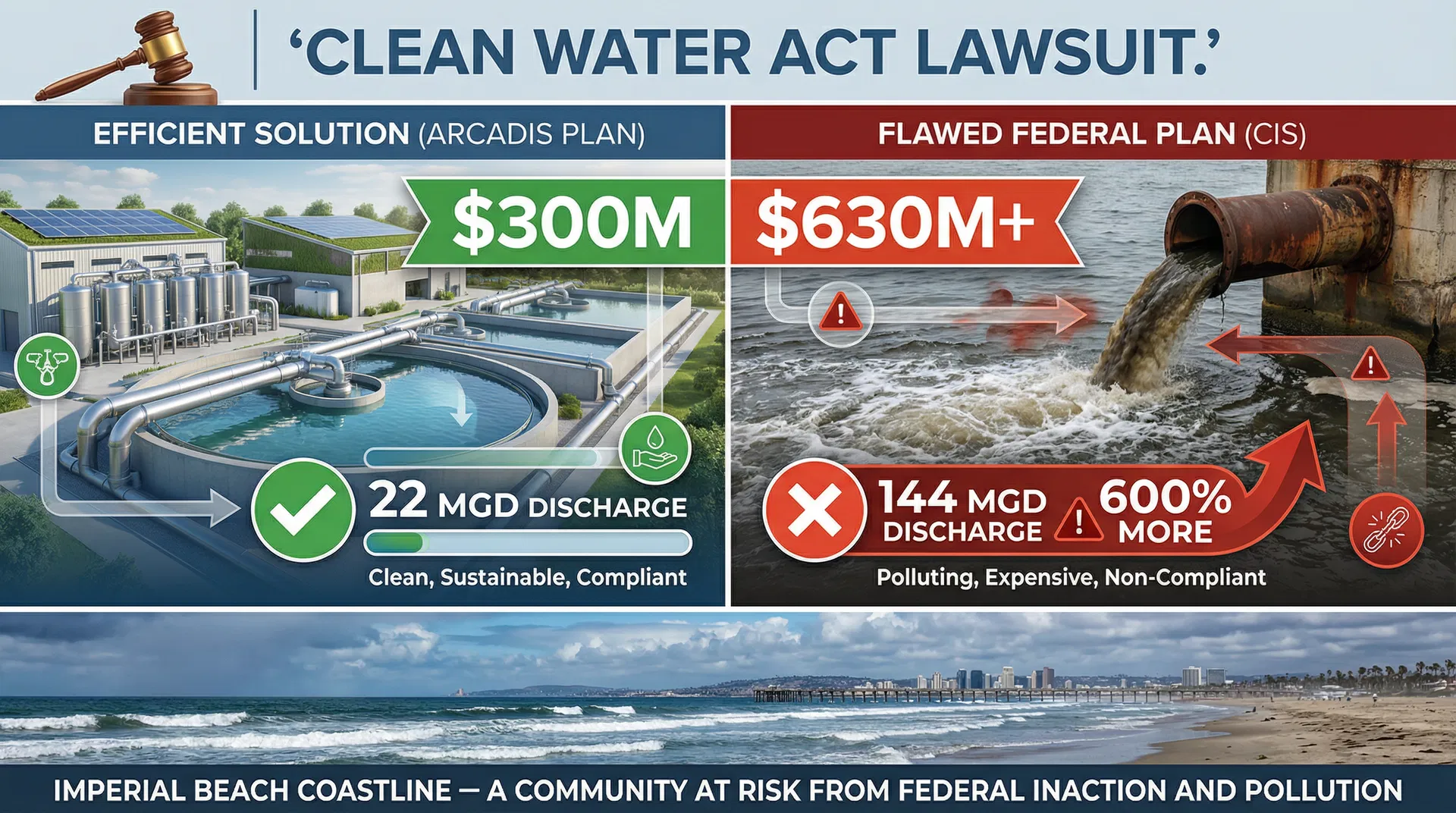
However, this clear and efficient engineering solution was never implemented. Instead, a complex series of events, catalyzed by a Clean Water Act lawsuit filed by the Surfrider Foundation and other environmental NGOs, led federal agencies to abandon the Arcadis plan. This report exposes how the well-intentioned legal pressure from these groups inadvertently created a "bait and switch," pushing the U.S. Environmental Protection Agency (EPA) and the International Boundary and Water Commission (IBWC) toward a far more expensive and expansive strategy. The new plan, while celebrated by the NGOs, sets the stage for a future with a 600% increase in the potential volume of sewage discharged off the coast of Imperial Beach, effectively transforming a U.S.-funded environmental solution into a publicly funded utility for future urban and resort development in Mexico.
The Lawsuit that Changed Everything
On July 17, 2018, frustrated by decades of government inaction, the Surfrider Foundation, alongside the cities of Imperial Beach, Chula Vista, and the Port of San Diego, filed a lawsuit against the IBWC. The suit alleged that the agency was violating the Clean Water Act by allowing the continuous, illegal discharge of untreated sewage and other pollutants into U.S. waters. This legal action became the critical lever that would fundamentally alter the course of the border sewage solution.
When the IBWC's attempt to have the case dismissed on grounds of sovereign immunity failed in December 2018, the federal government was forced to the negotiating table. Shortly thereafter, the $300 million in USMCA funding was secured, explicitly to address the crisis. However, the path forward was no longer a simple matter of implementing the most efficient engineering plan. The solution now had to satisfy the demands of the powerful environmental NGOs who were the plaintiffs in the ongoing litigation.
From Engineering Plan to Litigation Settlement: The Birth of the CIS
While the lawsuit was active, the EPA initiated a new "Alternatives Analysis" process, effectively sidelining the 2019 Arcadis plan. In parallel, Surfrider and its partners developed their own set of "stakeholder solutions." The outcome of this process was revealed on November 8, 2021, when the EPA announced it had selected a new path forward: the Comprehensive Infrastructure Solution (CIS) Alternative I-2.
This was the turning point. The CIS was not the Arcadis plan. It was a larger, more complex, and more expensive collection of projects heavily focused on building new treatment infrastructure on the U.S. side of the border. Crucially, Surfrider publicly celebrated this new plan, stating in their official comments on the Draft PEIS that the CIS "closely reflect[s] the stakeholder solutions that the San Diego Chapter worked hard to develop over several years".
With the EPA's commitment to the NGO-preferred plan in hand, the lawsuit was settled in April 2022. The environmental groups had won, securing a government commitment to a plan they had heavily influenced. However, a closer look at the details of this new plan reveals a troubling departure from the original goal of stopping pollution at its source.
The Consequences of the Switch: Accommodating Mexico's Growth
The CIS plan, born from litigation, is designed not just to handle existing pollution, but to accommodate future growth. In their comments, Surfrider explicitly advocated for the largest possible expansion of the U.S. treatment plant (60 MGD) because it was "designed to accommodate population growth until 2050". They also pushed for "consideration of increased treatment ability to fully cover population growth until 2050" for the developments on the Mexican coast.
This is the core of the new, flawed strategy. The plan now facilitates the decommissioning of crucial pump stations in Tijuana that once sent sewage south, away from the U.S. border. Now, that sewage will flow by gravity directly into the United States, where the new, expanded, and U.S.-taxpayer-funded treatment plants will be waiting. The system is being built to handle the wastewater needs of future developments in Mexico, including the burgeoning "Pacific Riviera" of coastal resorts and casinos.
The 163 MGD figure, which represents a 600% increase over the existing 25 MGD plant, is the maximum capacity of the South Bay Ocean Outfall. While the immediate expansion is to 95 MGD, the long-term strategy, as identified in reports like the one authorized by California's SB 507, is to build a system capable of handling this much larger volume. The EPA and IBWC, under pressure from the lawsuit, have set a course to make the U.S. responsible for treating a vastly larger quantity of Mexican sewage for decades to come.
Conclusion: A Cautionary Tale of Unintended Consequences
The Surfrider lawsuit was born of a genuine and justified frustration with a decades-long environmental crisis. However, the outcome serves as a stark cautionary tale. By leveraging litigation to force a solution, the environmental NGOs inadvertently pushed federal agencies away from a targeted, efficient engineering plan and toward a far more expansive and costly one that serves the interests of future development in Mexico.
The "bait and switch" was not a malicious plot by the EPA, but a predictable outcome of a process where the primary goal shifted from solving an environmental problem to settling a lawsuit. The result is a plan that will manage, rather than prevent, pollution. It will lead to a massive increase in the volume of treated sewage discharged into U.S. waters and will commit U.S. taxpayers to funding the wastewater infrastructure for another country's growth.
The residents of San Diego are now faced with a future where their coastline is protected not by stopping pollution at its source, but by building a larger pipeline to discharge it just a few miles offshore. This is not the victory that was promised. It is a costly compromise that fails to address the root of the problem and sets a dangerous precedent for environmental management on the border.
References
[1] Arcadis. (2019). Tijuana River Diversion Study: Flow Analysis, Infrastructure Diagnostic and Alternatives Development.
[2] Surfrider Foundation. (2022, April 13). Surfrider Lawsuit Improves Ocean Water Quality and Protects Public Health at the Border.
[3] U.S. Environmental Protection Agency. (2021, November). Water Infrastructure Alternatives Analysis Final Report.
[4] Surfrider Foundation & Outdoor Outreach. (2022, August 1). RE: NEPA Draft PEIS Comments for Tijuana River Watershed, San Diego County, California.
[5] Coronado Times. (2020, October 1). Tijuana River Valley Legislation Signed into Law.
Learn More About the Tijuana River Sewage Crisis
For a comprehensive overview of the crisis, the efficient Arcadis solution we advocate for, and how you can help, visit our complete guide to the Tijuana River sewage crisis [blocked].
C4CC's Track Record: Why You Should Trust Our Analysis
In 2019, C4CC warned that Surfrider Foundation's sewage plan would exacerbate the crisis and increase beach closures. For publishing this factual analysis, we received cease and desist letters threatening legal action. We were excluded from "stakeholder" meetings.
We were right. Imperial Beach now suffers 3+ years of continuous beach closures—from 30 days/year to over 1,000 consecutive days closed. Everything we predicted came true.
Read how C4CC's 2019 predictions were vindicated: Our Impact Timeline [blocked]
This track record of accurate analysis—despite institutional opposition—validates C4CC's current PBCILA solution. When we say operating pumps 24/7 will reduce pollution by 78%, we have the data, the expertise, and the proven credibility to back it up.