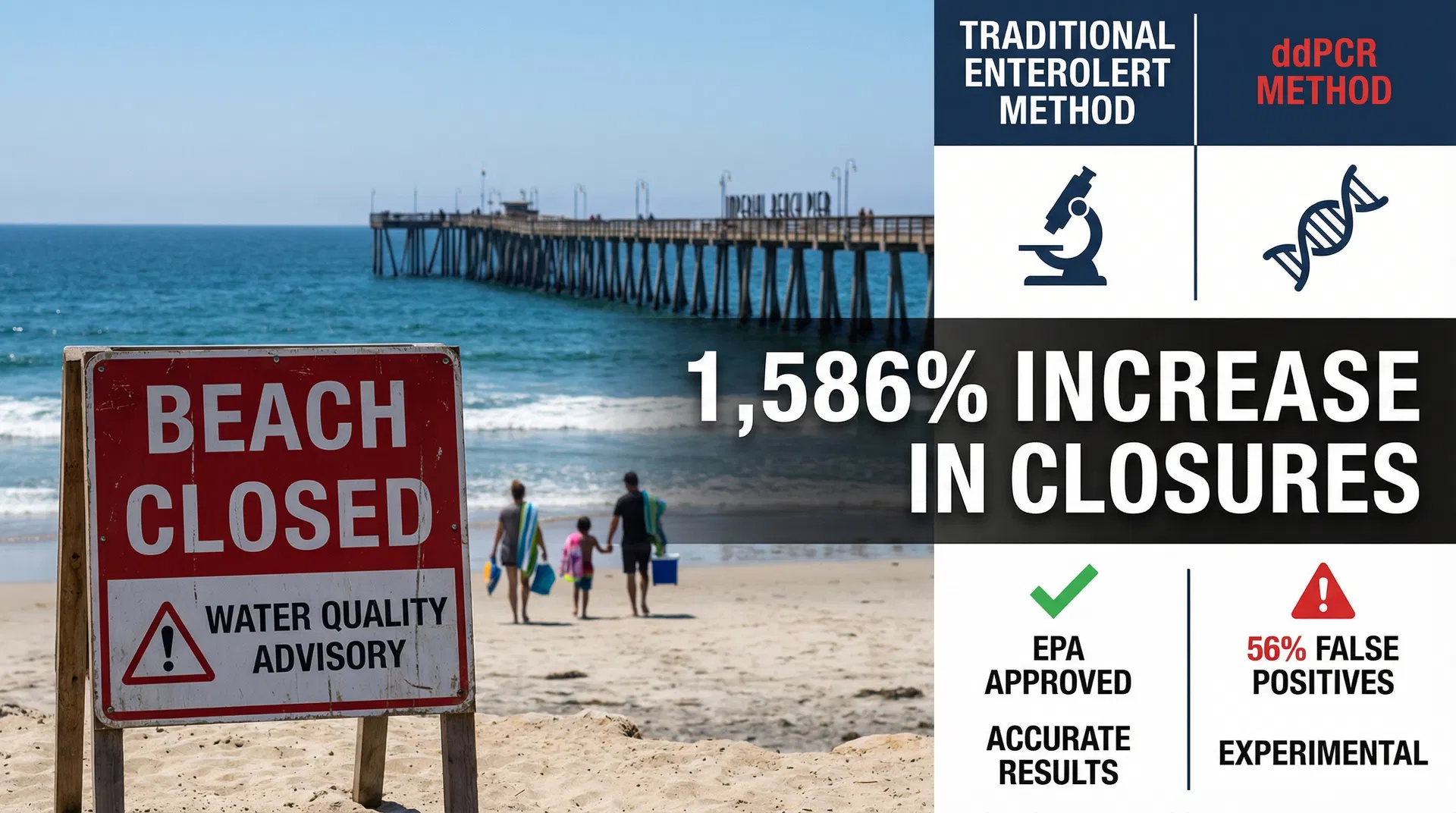
If you've tried to visit Imperial Beach, Coronado, or any South Bay beach in the past two years, you've probably seen the dreaded "Beach Closed" signs more often than not. While officials blame the Tijuana River sewage crisis for these closures, there's another culprit that no one is talking about: a fundamentally flawed water testing method that was implemented without proper validation.
The shocking truth? More than half of these beach closures are false alarms. Our beaches are being closed when the water is actually safe to swim in, and it's all because San Diego County switched to a testing method that doesn't meet EPA requirements and has a documented 56.3% false positive rate.
Citizens for Coastal Conservancy (C4CC) is the only local nonprofit organization investigating this issue and demanding accountability. Here's what everyone needs to know about the faulty ddPCR testing that's keeping our beaches unnecessarily closed.
The Testing Method That Changed Everything
For decades, beaches worldwide have used a culture-based testing method called Enterolert to measure bacteria levels in ocean water. This method detects live, culturable bacteria—the kind that can actually make you sick. California's Beach Action Value (BAV) for Enterolert is 104 MPN (Most Probable Number) per 100 milliliters of water. When bacteria levels exceed this threshold, beaches get closed to protect public health.
But in May 2022, San Diego County made a dramatic change. The County Department of Environmental Health and Quality (DEHQ) switched from Enterolert to a newer molecular method called droplet digital PCR (ddPCR) and established a new BAV of 1,413 copies per 100 milliliters.
County officials claimed this new method would provide "faster results" and "better protect public health." What they didn't tell the public was that ddPCR had never been properly validated against the approved EPA method, and that it would lead to a massive increase in beach closures—even when water quality hadn't actually changed.
Who Authorized This Unproven Method?
Here's where the story gets troubling. The EPA has strict requirements for alternative testing methods. According to the EPA's Technical Support Materials for Alternative Indicators and Methods, any new testing method must have a "consistent and predictable relationship" with the approved method before it can be used for regulatory decisions.
Specifically, the EPA requires either:
- An Index of Agreement (IA) of 0.70 or higher, OR
- An R² correlation value greater than 0.60
San Diego County received EPA approval in October 2020 to use ddPCR as a "pilot program." But here's the problem: the County's own data shows ddPCR doesn't meet either EPA requirement.
A peer-reviewed study published in January 2026 in the Journal of Microbiological Methods analyzed water samples collected simultaneously from Coronado beaches during summer 2023. Researchers tested the same water using both Enterolert and ddPCR to see if the methods agreed. The results were damning:
- Index of Agreement: 0.25 (EPA requires ≥0.70)
- R² correlation: 0.41 (EPA requires >0.60)
Neither EPA requirement was met. Yet San Diego County continues to use ddPCR to make beach closure decisions that affect millions of residents and visitors.
The question everyone should be asking is: Who authorized the use of an unvalidated testing method that doesn't meet EPA standards? And why is it still being used after independent research proved it doesn't work as claimed?
The Numbers Don't Lie: A 1,586% Increase in Beach Closures
The impact of switching to ddPCR has been devastating for South Bay communities. Let's look at what happened to Coronado beaches—and remember, these are beaches located miles north of the Tijuana River, not right at the pollution source.
Coronado Beach Closure Rates:
- 2019-2022 (Enterolert method): 3.6% of samples exceeded the BAV
- 2022-2024 (ddPCR method): 60.7% of samples exceeded the BAV
That's not a typo. Beach closures increased by 1,586% after switching to ddPCR—even though the actual water quality didn't suddenly become 17 times worse.
County-wide, the story is similar:
- Enterolert method: 6.6% exceedance rate
- ddPCR method: 59.2% exceedance rate
This represents a 797% increase in beach closures across all San Diego County beaches.
The 56% False Positive Problem
The Coronado study revealed the most damning statistic of all: ddPCR has a 56.3% false positive rate when compared to the EPA-approved Enterolert method.
What does this mean in plain English? More than half the time ddPCR says a beach should be closed, the approved testing method would say it's safe to swim.
During the summer 2023 study period in Coronado:
- Median ddPCR reading: 1,669 copies/100mL (ABOVE the 1,413 BAV—beach closed)
- Median Enterolert reading: 7.8 MPN/100mL (FAR BELOW the 104 BAV—beach open)
The same water, tested on the same day, at the same time. One method says close the beach. The other says it's perfectly safe. And we're using the method that closes beaches more than half the time when they should be open.
Why ddPCR Gives False Positives: Dead Cells and DNA Fragments
To understand why ddPCR produces so many false positives, you need to understand what each method actually detects.
Enterolert (the approved method) detects only live, culturable bacteria that can grow and potentially cause infection. If bacteria are dead or damaged, Enterolert won't count them—because dead bacteria can't make you sick.
ddPCR (the County's method) detects all DNA, including:
- Live bacteria that could cause illness
- Dead bacteria cells that pose no health risk
- Non-culturable bacteria that can't grow or cause infection
- Free-floating DNA fragments in the water
- DNA from bacteria that died days or weeks ago
Think of it this way: Enterolert asks "Are there living bacteria here that could make swimmers sick?" ddPCR asks "Is there any bacterial DNA here, dead or alive?"
This fundamental difference explains why ddPCR readings stay elevated long after actual health threats have passed. After storms or sewage spills, dead bacteria and DNA fragments can persist in the water for days or weeks. Enterolert correctly identifies that these remnants pose no health risk. ddPCR triggers beach closures based on genetic material from bacteria that died long ago.
The Hurricane Hilary Evidence
Hurricane Hilary in August 2023 provided a perfect natural experiment that exposed ddPCR's flaws. The storm brought 1.8 inches of rain and caused the Tijuana River discharge to spike from less than 10 million gallons per day (MGD) to over 1,000 MGD.
Both testing methods showed elevated bacteria levels immediately after the storm—exactly what you'd expect. But here's what happened next:
Enterolert concentrations quickly returned to safe levels within a few days, correctly indicating that live bacteria had been diluted and died off.
ddPCR concentrations stayed elevated for weeks, continuing to trigger beach closures long after the actual health threat had passed.
Why? Because ddPCR was detecting DNA fragments and dead cells from the storm runoff—biological debris that posed zero health risk but kept beaches closed unnecessarily.
Imperial Beach Bears the Brunt
The false positive problem isn't evenly distributed across San Diego County. The research revealed a troubling spatial pattern: the closer a beach is to the Tijuana River, the worse the false positive rate becomes.
Imperial Beach and South Bay beaches—the communities closest to the border—experience the highest rates of unnecessary closures. The relationship is nearly linear: distance from the Tijuana River directly correlates with the severity of ddPCR's false positive problem.
This means the communities already suffering the most from actual cross-border sewage pollution are being hit with a double whammy: real pollution events PLUS false alarms that close beaches even when water is safe.
The economic impact on Imperial Beach has been catastrophic. Local businesses that depend on beach tourism have seen revenues plummet. Property values have declined. The community's quality of life has been severely diminished—not just by actual sewage pollution, but by a flawed testing method that exaggerates the problem.
Why Isn't Anyone Else Talking About This?
Here's the uncomfortable truth: C4CC is the only local nonprofit organization investigating and exposing the ddPCR testing problem.
Other environmental groups and stakeholders have either remained silent or actively supported the County's switch to ddPCR, perhaps believing that more beach closures equal more pressure to solve the Tijuana sewage crisis. But this logic is deeply flawed.
False beach closures don't help solve the sewage crisis—they obscure it. When beaches are closed 60% of the time based on false positives, it becomes impossible to distinguish real pollution events from testing artifacts. This makes it harder, not easier, to hold polluters accountable and track the effectiveness of solutions.
Moreover, crying wolf with false beach closures erodes public trust. When residents see beaches closed on beautiful days with crystal-clear water, they stop believing the warnings—even when real pollution events occur.
C4CC believes in science-based decision making. We support beach closures when water quality genuinely poses a health risk. But we refuse to accept a flawed testing system that closes beaches unnecessarily more than half the time, especially when it disproportionately harms the South Bay communities we serve.
The Rest of the World Uses Enterolert. Why Did San Diego Change?
Here's a question worth asking: If ddPCR is supposedly superior to Enterolert, why does the rest of the world still use culture-based methods?
Enterolert and similar culture-based methods are the global standard for beach water quality monitoring. They're used throughout the United States, Europe, Australia, and virtually every country with established beach monitoring programs. These methods have decades of validation, extensive health studies linking bacteria levels to swimmer illness rates, and proven track records of protecting public health.
ddPCR is newer and faster—results can be obtained in a few hours instead of overnight. But speed means nothing if the results are wrong. And the research clearly shows ddPCR produces false positives more than half the time when compared to the validated method.
San Diego County justified the switch by citing a 2021 study that claimed to show agreement between ddPCR and Enterolert. But that study had serious methodological problems:
- It used a modified EPA protocol that scaled ddPCR values before calculating agreement—essentially adjusting the data to make it look better
- It pooled data from 51 different beach sites across the entire county, masking site-specific problems
- It didn't account for spatial and temporal variability that affects the relationship between methods
When independent researchers conducted a proper validation study at Coronado beaches—using the actual EPA protocol without data manipulation—ddPCR failed both EPA requirements. This is why peer-reviewed science matters.
What Needs to Happen Now
C4CC is calling for immediate action to address the ddPCR testing crisis:
1. Return to EPA-Approved Testing Methods
San Diego County should immediately return to using Enterolert or other EPA-approved culture-based methods for beach closure decisions. ddPCR can be used as a supplementary rapid screening tool, but it should not be the sole basis for closing beaches.
2. Independent Review and Accountability
The California State Water Resources Control Board should conduct an independent review of San Diego County's decision to implement ddPCR without proper validation. Who authorized this change? What data did they rely on? Why were EPA requirements ignored?
3. Reopen Falsely Closed Beaches
Historical beach closure data from 2022-2024 should be re-evaluated using the approved Enterolert method. Beaches that were closed based solely on ddPCR false positives should be retroactively cleared, and affected communities should receive economic relief.
4. Transparent Reporting
San Diego County should publicly report both ddPCR and Enterolert results for all beach samples, allowing the public to see the discrepancies for themselves. Transparency builds trust.
5. Focus on Real Solutions
Instead of closing beaches unnecessarily with flawed testing, we should focus on C4CC's proven solution: operating the PBCILA diversion pumps at full capacity 24/7. Our data shows this can reduce transboundary sewage flows by 78%—from 138 days per year to just 30 days—using existing infrastructure at a fraction of the cost of proposed new treatment plants.
C4CC: The Only Local Voice Fighting for Science-Based Beach Management
Citizens for Coastal Conservancy is the only local nonprofit organization in the Tijuana River watershed fighting for both clean beaches AND accurate testing. We're not afraid to challenge flawed policies, even when it means standing alone.
We believe Imperial Beach and South Bay communities deserve:
- Accurate information about when beaches are truly unsafe
- Science-based decisions that follow EPA requirements
- Accountability from officials who implement unvalidated methods
- Real solutions to the sewage crisis, not just more beach closures
The ddPCR testing scandal is just one example of how South Bay communities have been failed by agencies that should be protecting them. While other organizations focus on distant treatment plant proposals that will take decades and billions of dollars, C4CC is fighting for immediate, cost-effective solutions using proven technology.
What You Can Do
If you're tired of seeing your beaches closed unnecessarily, here's how you can help:
-
Share this article with friends, family, and on social media. The more people who understand the ddPCR problem, the harder it becomes to ignore.
-
Contact San Diego County Supervisors and demand a return to EPA-approved testing methods. Ask them why the County is using a method that doesn't meet EPA requirements.
-
Support C4CC's work by donating, volunteering, or attending our monthly community meetings. We're the only local organization investigating these issues and demanding accountability.
-
Demand transparency from the California State Water Resources Control Board. Ask them to review San Diego County's ddPCR implementation and explain why EPA requirements were waived.
-
Spread the word about C4CC's solution: Operating PBCILA pumps at full capacity 24/7 can reduce transboundary pollution by 78% using existing infrastructure. No new treatment plants needed. No decades-long delays. Just proven technology and political will.
The Bottom Line
Imperial Beach and South Bay beaches are being closed more than half the time based on false alarms from a testing method that doesn't meet EPA standards. This isn't just a technical problem—it's an injustice that disproportionately harms the communities already suffering most from cross-border sewage pollution.
While other organizations remain silent or focus on distant solutions, C4CC is fighting for immediate accountability and science-based beach management. We're exposing the flawed testing that keeps beaches unnecessarily closed, and we're pushing for proven solutions that can reduce actual sewage pollution by 78% starting today.
The question is simple: Do you want beach closures based on science, or based on a flawed testing method that fails EPA requirements?
C4CC chooses science. Join us in demanding the same from San Diego County.
Learn More About the Tijuana River Sewage Crisis
For a comprehensive overview of the crisis, our proven solution, and how you can help, visit our complete guide to the Tijuana River sewage crisis [blocked].
Why C4CC's Analysis Matters
C4CC has a proven track record of accurate predictions. In 2019, we warned that expanding sewage treatment without addressing root causes would worsen the crisis. We received cease and desist letters for speaking truth to power. Today, Imperial Beach has suffered 3+ years of continuous beach closures—exactly what we predicted.
Read the full timeline: How C4CC's 2019 warnings came true [blocked]
When local voices with technical expertise are silenced by institutional power, communities pay the price. Our vindication on the 2019 predictions validates our current analysis of faulty water quality testing methods.