IBWC Minute Orders: 35 Years of Broken Promises on Cross-Border Sewage
For over three decades, the communities of Imperial Beach and Coronado have been plagued by cross-border sewage flows from Tijuana, Mexico. Despite a series of binational agreements known as Minute Orders issued by the International Boundary and Water Commission (IBWC), the problem has not only persisted but worsened. This comprehensive analysis reveals a disturbing pattern of unfulfilled commitments, contradictory language, and a systematic shift of the financial and environmental burden from Mexico to the United States.
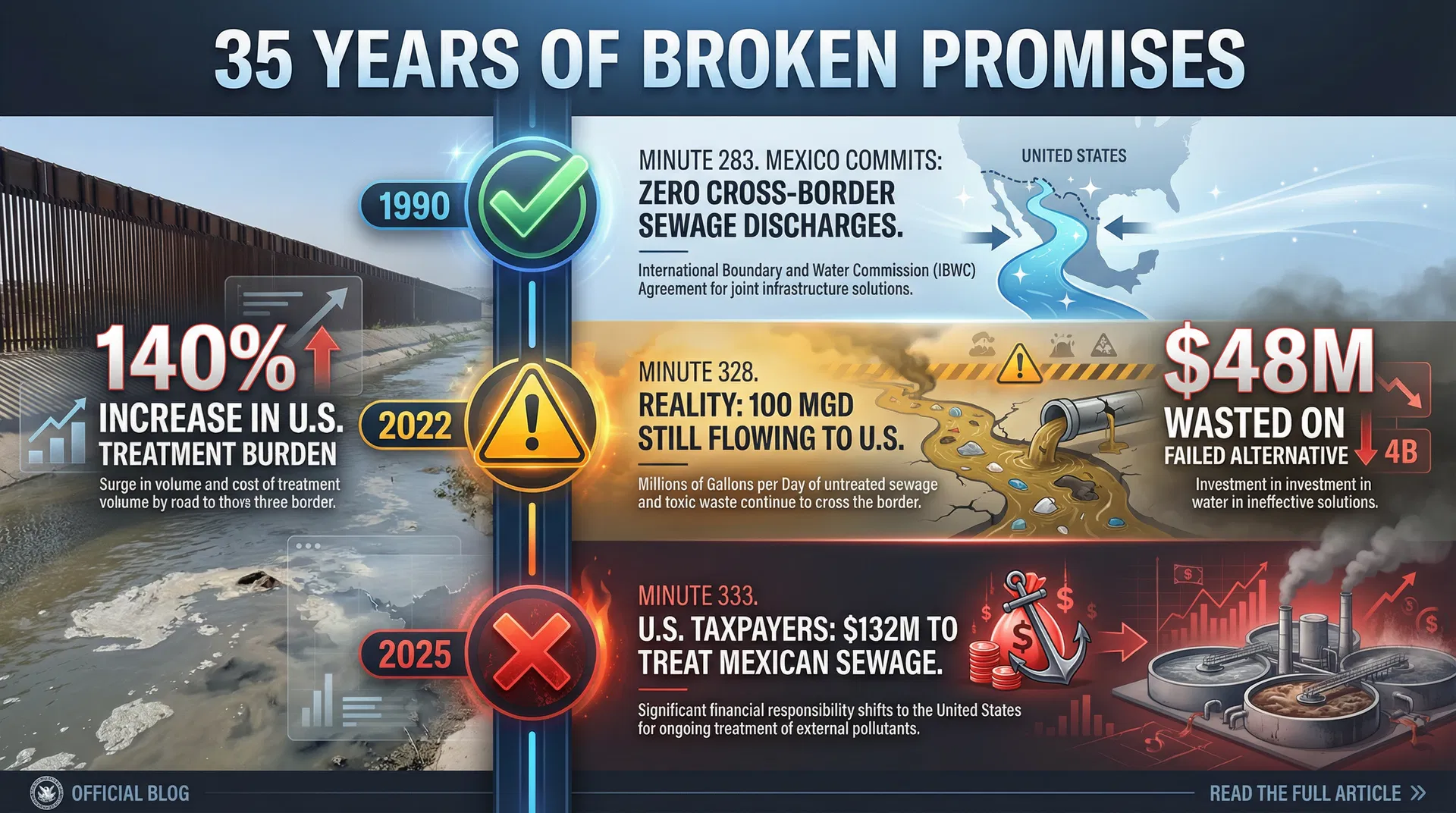
The Broken Promise of Minute 283
Minute No. 283, signed on July 2, 1990, established a clear and unambiguous commitment from the Government of Mexico:
Point 16: "The Government of Mexico will assure that there are no discharges of treated or untreated domestic or industrial wastewaters into waters of the Tijuana River that cross the international boundary, and that in the event of a breakdown in collection or other detention facilities designed to prevent such discharges, the Government of Mexico will take special measures to immediately stop such discharges and make repairs."
This foundational promise of zero cross-border discharges has been the basis of all subsequent agreements. However, as this analysis demonstrates, this commitment has been consistently violated for 35 years.
The Reversal: Minute 328 and the Plan to Increase Sewage Flows
Minute No. 328, signed on July 19, 2022, represents a fundamental reversal of the commitment made in Minute 283. Instead of preventing cross-border flows, Minute 328 outlines a plan to intentionally bring more Mexican sewage into the United States for treatment. This is explicitly stated in the description of projects to be undertaken by Mexico:
"Pursuant to Minute No. 283, construction of: A gravity sewer trunkline from Tijuana Pumping Plant No. 1 to the boundary; sewage collection works necessary to convey a portion of sewage from the City of Tijuana to the international sewage plant in the United States; and other sewage collection works."
This project, described as being "pursuant to Minute 283," directly contradicts the core principle of that same Minute. Instead of stopping sewage at the border, this new infrastructure is designed to facilitate its transfer into the United States.
The 140% Increase in U.S. Treatment Capacity
Minute 328 also outlines a plan to significantly expand the South Bay International Wastewater Treatment Plant (SBIWTP) in the United States to handle the increased flow of Mexican sewage:
| Plant Capacity | Flow Rate (MGD) | Flow Rate (lps) | Increase from Original |
|---|---|---|---|
| Current Capacity | 25 | 1,100 | 0% |
| Phase 1 Expansion | 50 | 2,191 | 100% |
| Potential Future Expansion | 60 | 2,629 | 140% |
This represents a potential increase of up to 140% in the volume of Mexican sewage being treated in the United States—a stark contradiction to the "zero discharge" promise of Minute 283.
The Unfavorable Investment Choice: Alternative 4B
Further compounding the issue is the selection of demonstrably inefficient and costly infrastructure projects. An analysis of investment options evaluated in the North American Development Bank (NADB) "Tijuana River Diversion Study" reveals that the chosen path, known as Alternative 4B, was one of the least favorable options considered.
Alternative 4B involves diverting up to 35 million gallons per day (MGD) to the existing South Bay International Wastewater Treatment Plant (SBIWTP). While its initial implementation cost of $52 million appeared relatively low, its long-term financial unsustainability is clear when compared to other options.
Comparison of Key Investment Alternatives
| Alternative | Description | Implementation Cost | Annual O&M | 10-Year Total Cost* | Flow Reduction |
|---|---|---|---|---|---|
| E (Alt 4B) | 35 mgd to EXISTING SBIWTP | $52M | $7.0M | $132M | 61% |
| A | 35 mgd to NEW SBIWTP | $78M | $1.9M | $107M | 61% |
| G | 50 mgd to Existing SBWRP | $83M | $1.5M | $108M | 70% |
| H | 193 mgd Pumped Direct to SBOO | $22M | $1.6M | $48M | 93% |
Total cost includes implementation, 10 years of O&M, and a $10M environmental monitoring fee.
As the data shows, Alternative 4B has the highest annual operating and maintenance (O&M) costs of all the primary options. Over a 10-year period, it is significantly more expensive than other alternatives that provide similar or even superior performance.
For example, Alternative H provides a 93% flow reduction for a 10-year total cost of just $48 million, while Alternative 4B achieves only a 61% reduction for a staggering $132 million over the same period. The selection of this economically unfavorable option further underscores a pattern of decisions that do not prioritize cost-effectiveness or sustainable long-term solutions, placing an undue and ongoing financial burden on U.S. communities.
The Missing Infrastructure: Unfulfilled Requirements of Minute 298
Minute No. 298, signed on December 2, 1997, required Mexico to construct a parallel pumping and conveyance system to handle its own wastewater. This included a new pumping plant with a capacity of 25 MGD (1,100 lps) and a conveyance system to an ocean discharge point.
However, Minute 328 makes no mention of Mexico fulfilling this requirement. Instead, it focuses on rehabilitating existing infrastructure and constructing a much smaller 18 MGD treatment plant at San Antonio de los Buenos. This represents a significant reduction in Mexico's commitment to building its own wastewater treatment capacity.
The Pattern of Deception: From Firm Commitments to Feasibility Studies
Minute No. 333, signed on December 15, 2025, continues this pattern of broken promises. The 18 MGD treatment plant at San Antonio de los Buenos, a firm commitment in Minute 328, is downgraded to a mere "feasibility study" in Minute 333. The only new treatment plant with a firm commitment in Minute 333 is the Tecolote-La Gloria plant, with a capacity of only 3 MGD (131 lps)—a fraction of what is needed.
Minute 333 itself acknowledges the failures of the past:
"The Commissioners acknowledged that despite the efforts that both Governments have made under the cited Minutes and other agreements of the Commission, it has not been possible to achieve a comprehensive solution to the San Diego-Tijuana border sanitation problem..."
This admission of failure, coupled with the continued reliance on studies and assessments rather than concrete action, suggests that Minute 333 is not a genuine solution but rather a continuation of a failed strategy.
The Financial Burden on U.S. Taxpayers
The cost of treating Mexico's sewage is largely borne by U.S. taxpayers. Under Minute 328, the United States is responsible for:
- 100% of the $300 million capital costs for the expansion of the SBIWTP
- 80% of the operation and maintenance costs for the expanded SBIWTP through 2032
Mexico's contribution is a mere $1.62 pesos per cubic meter (approximately $0.08 USD)—a fraction of the actual cost.
What This Means for South Bay Communities
The implications of these broken promises are devastating for Imperial Beach, Coronado, and South Bay residents:
Economic Impact:
- Lost tourism revenue as visitors avoid the region
- Business closures and declining property values
- Wasted public resources on unnecessary beach closures
Public Health Crisis:
- Over 1,000 consecutive days of beach closures in some locations
- Exposure to untreated sewage and contaminated water
- Increased health risks for residents and visitors
Environmental Justice:
- Disproportionate impact on low-income communities of color
- Imperial Beach residents—predominantly Latino and working-class—bear the brunt
- Wealthier communities would never tolerate such conditions
C4CC's Alternative: The Efficient Solution They Don't Want You to Know
While federal agencies pursue expensive, inefficient plans that increase U.S. treatment of Mexican sewage, Citizens for Coastal Conservancy advocates for a proven alternative: operating PBCILA at full capacity.
Our approach can reduce transboundary pollution by 78% using off-the-shelf technology at a fraction of the cost of new treatment plants. Unlike the federal plan that will discharge 600% more sewage off Imperial Beach, C4CC's solution actually reduces cross-border flows—honoring the original spirit of Minute 283.
Conclusion: Time for Accountability
The analysis of these IBWC Minute Orders reveals a clear and disturbing pattern. The foundational commitment made in 1990 to prevent all cross-border sewage discharges has been abandoned. Instead, a series of subsequent agreements have shifted the policy to one of facilitating and expanding the treatment of Mexican sewage in the United States, with U.S. taxpayers bearing the majority of the cost.
The citizens of Imperial Beach and Coronado have been subjected to the environmental and health consequences of this failed policy for too long. It is time for the U.S. government to:
- Hold Mexico accountable for its original commitment to prevent all cross-border sewage discharges
- Demand transparency in the selection of infrastructure projects and cost allocation
- Prioritize cost-effective solutions like C4CC's PBCILA approach that actually reduce cross-border flows
- Ensure environmental justice for the communities that have suffered for 35 years
Citizens for Coastal Conservancy will continue to expose these broken promises and advocate for genuine, lasting solutions to the Tijuana River sewage crisis [blocked].
References
- International Boundary and Water Commission, Minute No. 283, "Conceptual Plan for the International Solution to the Border Sanitation Problem in San Diego, California/Tijuana, Baja California," July 2, 1990.
- International Boundary and Water Commission, Minute No. 328, "Sanitation Infrastructure Projects in San Diego, California – Tijuana, Baja California for Immediate Implementation and for Future Development," July 19, 2022.
- International Boundary and Water Commission, Minute No. 298, "Recommendations for Construction of Works Parallel to the City of Tijuana, B.C. Wastewater Pumping and Disposal System and Rehabilitation of the San Antonio de los Buenos Treatment Plant," December 2, 1997.
- U.S. Environmental Protection Agency, "Minute No. 333," December 15, 2025.
- County of San Diego, "Attachment A to Agenda File No. 2019-0461: Draft Joint Resolution of State and Local Stakeholders Recommending Project Alternatives and Federal Actions to Eliminate Detrimental Transboundary Flows of Wastes in the Tijuana River Valley," December 3, 2019.
C4CC's Track Record: Why You Should Trust Our Analysis
In 2019, C4CC warned that Surfrider Foundation's sewage plan would exacerbate the crisis and increase beach closures. For publishing this factual analysis, we received cease and desist letters threatening legal action. We were excluded from "stakeholder" meetings.
We were right. Imperial Beach now suffers 3+ years of continuous beach closures—from 30 days/year to over 1,000 consecutive days closed. Everything we predicted came true.
Read how C4CC's 2019 predictions were vindicated: Our Impact Timeline [blocked]
This track record of accurate analysis—despite institutional opposition—validates C4CC's current PBCILA solution. When we say operating pumps 24/7 will reduce pollution by 78%, we have the data, the expertise, and the proven credibility to back it up.