What We Measured
From November 15, 2025 to April 7, 2026, Citizens for Coastal Conservancy monitored hydrogen sulfide (H₂S) levels at two critical locations while tracking sewage flow in the Tijuana River Valley. H₂S is the chemical that creates that distinctive rotten-egg smell—and it's a direct indicator of raw sewage concentration in the air.
During this period, Mexico's PBCILA pump station was completely offline. No pumps. No treatment. Just 143 days of pure sewage flowing into the Tijuana River.
The Data Doesn't Lie
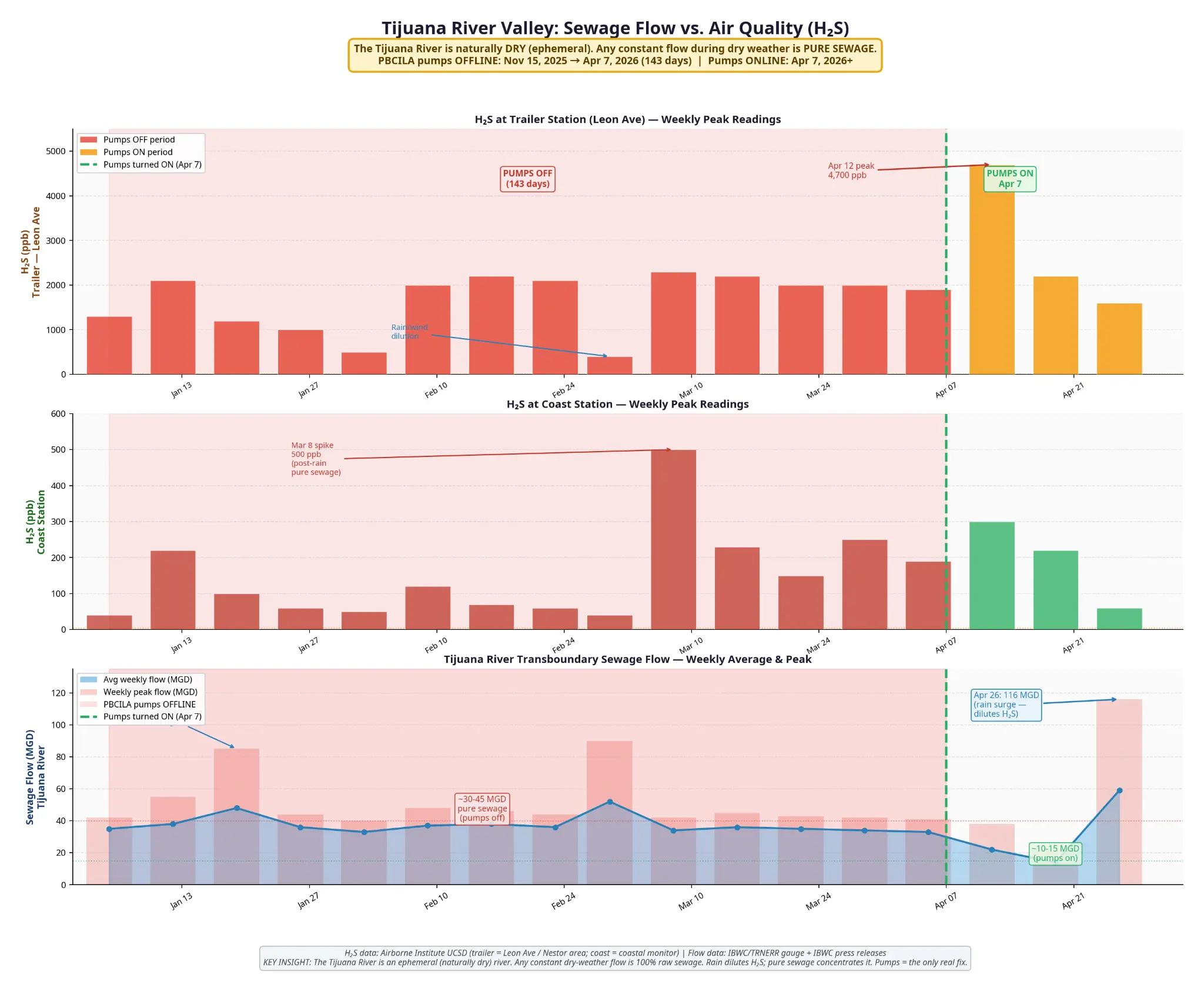
Panel 1: H₂S at Trailer Station (Leon Avenue)
The red bars tell a story of relentless toxicity. Throughout the entire pump-off period, H₂S levels remained persistently elevated at 1,000–2,300 ppb (parts per billion). That's not a spike. That's the baseline for a naturally dry river receiving untreated sewage.
The worst reading came on April 12—just five days after the pumps turned back on—when H₂S hit 4,700 ppb. This wasn't a failure of the pumps; it was the last gasp of accumulated toxins being flushed from the system. Within days, as the pumps continued operating, readings began declining.
Panel 2: H₂S at Coast Station
The coastal monitoring station showed the same pattern at lower intensity, but with a crucial detail: the March 8 spike to 500 ppb. This happened immediately after a rain event. Rain temporarily diluted the sewage, but when it stopped, the dilution effect ended—creating a spike of pure, undiluted sewage odor.
Panel 3: Sewage Flow
The blue line reveals the mechanical reality. During the pump-off period, the river maintained a baseline flow of 30–45 million gallons per day (MGD)—all raw sewage from Tijuana. When the pumps turned on April 7, flow immediately dropped to 10–15 MGD.
The Proof
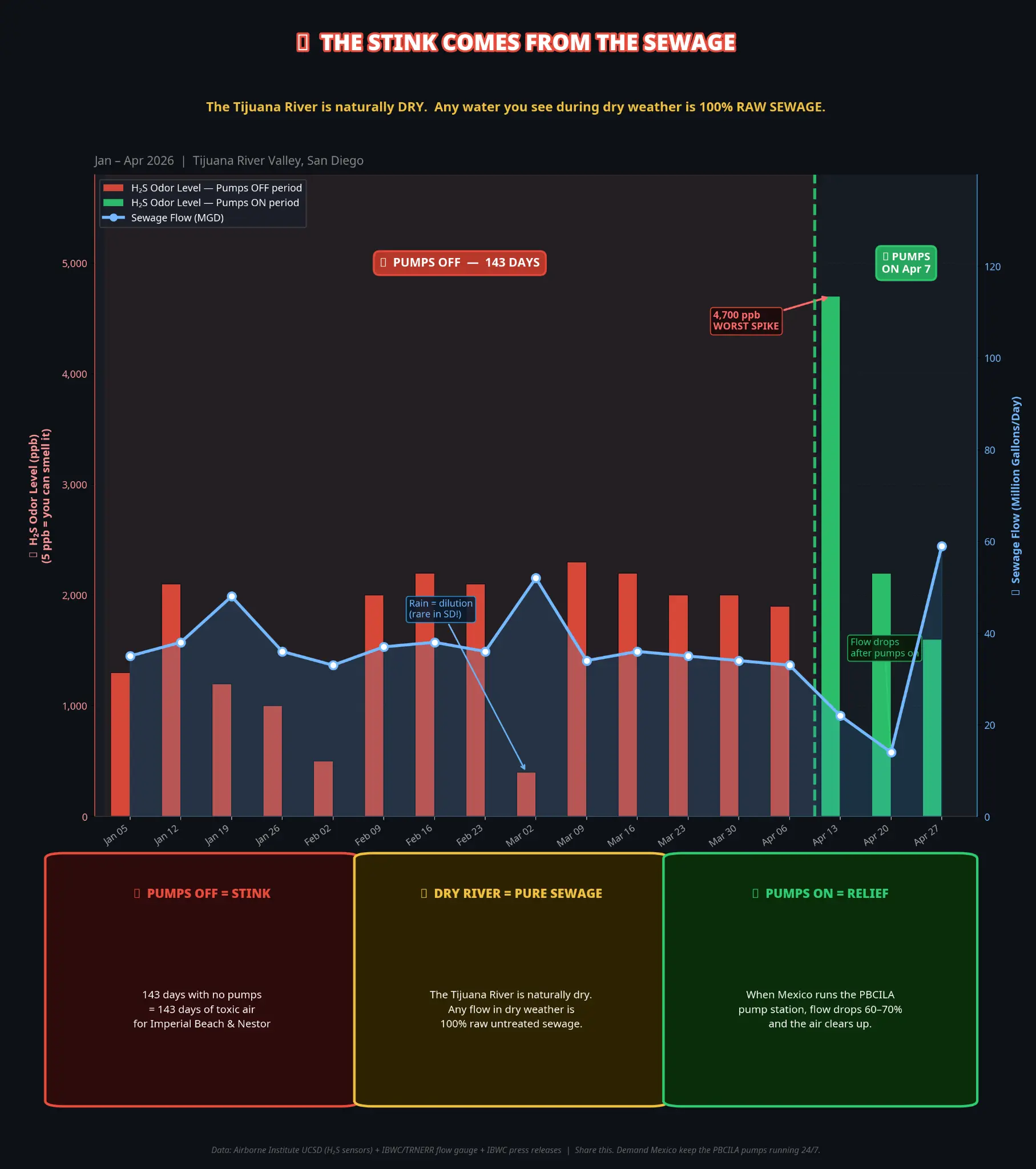
This data proves what Imperial Beach residents have known for years: the Tijuana River is naturally dry. Any water flowing during dry weather is 100% raw sewage. The stink comes from the sewage.
The Solution
The solution is keeping the pumps on. When Mexico operates the PBCILA pump station, it diverts 60–70% of the transboundary sewage away from the river valley. The air clears. The beaches open. The community breathes.
Citizens for Coastal Conservancy is calling for:
- 24/7 Pump Operation - The PBCILA pumps must run continuously during dry weather to prevent raw sewage from flowing into the river valley.
- Reliable Funding - Mexico needs consistent, dedicated funding to maintain and operate the pump system without interruption.
- Accountability - Both governments must commit to transparent monitoring and public reporting of sewage flow and air quality data.
- Long-Term Infrastructure - While the pumps are essential now, a permanent solution requires investment in wastewater treatment infrastructure on both sides of the border.
The Bottom Line
The data is clear. The science is sound. The solution is proven.
The stink comes from the sewage. The sewage comes from a dry river receiving untreated transboundary flows. The solution is keeping the pumps running.
Imperial Beach and South Bay deserve clean air and healthy beaches. The PBCILA pump system makes that possible. It's time for both governments to commit to operating it reliably, consistently, and permanently.
Data Source: Airborne Institute (UCSD) H₂S sensors, Leon Ave & Nestor area; Coast monitoring station; IBWC/JIWC flow gauge data
Methodology: Weekly peak H₂S readings during pump-off period (Nov 15, 2025 – Apr 7, 2026) and pump-on period (Apr 7, 2026+). Flow data represents daily average and peak flows from IBWC monitoring.